
VALUE MAP
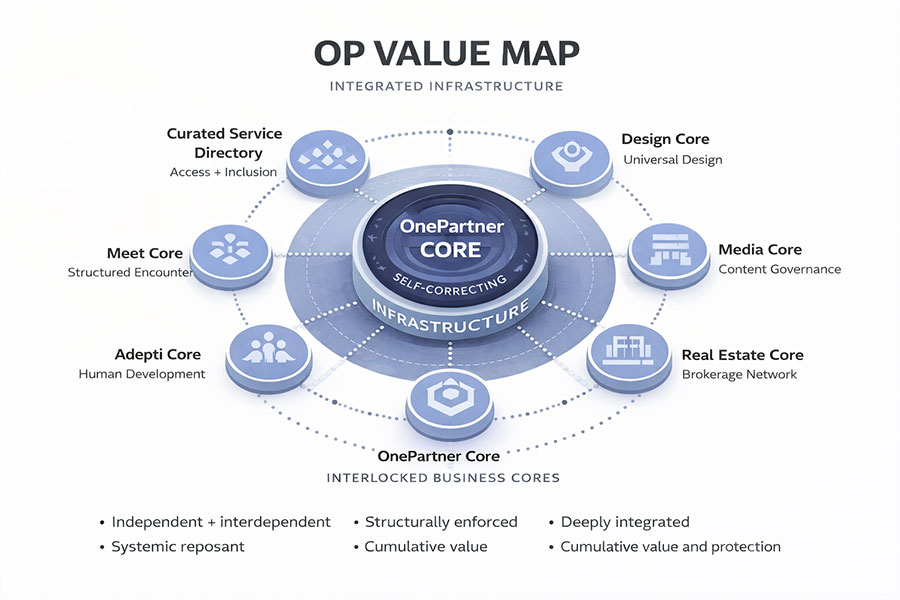
Core Business Architecture
OP is not built around a single service or directory.
It is built around multiple independent core businesses, each designed to stand on its own — and intentionally integrated into one infrastructure.
Each core addresses a real, identified gap in how services, expertise, and experiences are accessed today.
Individually, these cores are viable businesses.
Together, they form a structure that is difficult to replicate and impossible to replace with a single solution.
A defining principle across all OP cores is this:
OP does not own service providers.
Instead, OP curates, structures, and sells services individually — and combines them into new, unique service experiences that would not exist without the infrastructure.
How the Structure Is Operated
All OP core businesses are governed through a central core team and supported by domain-specific local operators.
Operations are managed through:
- OP service-point platforms (digital)
- OP service-point locations (physical)
This ensures:
- consistent quality
- controlled inclusion
- long-term partner stability
- unified customer experience
Local execution exists, but structural control remains centralized.
More Than a Directory
What OP provides is not “more services”, but better access.
The common thread across all cores is:
- curated access
- verified expertise
- reduced noise and competition
- trust as infrastructure
The world does not need more providers.
It needs a better way to reach the right one — and combine them meaningfully.
Core Business Domains
Below are the primary OP core businesses, each with its own independent logic and role within the integrated structure.
1. OnePartner Core
Independent Business Logic
What it is
Structured access layer to the best services per category, per area.
Problem it solves
- fragmented directories
- uncontrolled competition
- advertising-driven visibility
How it works
- one partner per category
- long-term stability
- OP-controlled inclusion
Revenue logic
- commission-based
- recurring
- scales with usage
Why it fails without OP
- no trust layer
- no enforcement
- no visibility coherence
2. Curated Service Directory
Independent Business Logic
OnePartner is a curated access infrastructure connecting people to one trusted expert per industry and region.
Experts are carefully selected and verified for quality, reliability, and real value. The world doesn’t need more services.
It needs a better way to access the right one.
3. Design Core
Independent Business Logic
What it is
Universal operational design system. Curated design professionals selected for quality, clarity, and execution.
Why it matters
- immediate trust
- recognizability
- spatial + digital coherence
Why it is not “branding”
It dictates how services are accessed and experienced, not how they look.
4. Media Core
Independent Business Logic
What it is
Centrally governed content and relevance system. Independent, curated media focused on quality over promotion.
Stories, visibility, and credibility for verified OnePartners.
Role
- keeps system alive
- maintains interest
- prevents decay
Revenue logic
(indirect + direct)
5. Service point, travel Core
Independent Business Logic
What it replaces
Traditional tourist offices. A physical and digital access point for verified local services.
Guidance, coordination, and trusted entry into the OnePartner network.
Service Office Info Point renews and replaces outdated tourist information offices by restoring reliable access to local services and verified information.
Why it works now
- tourist offices died
- platforms don’t guide
- trust gap exists
Revenue logic
- immediate
- front-facing
- scalable per location
6. Real Estate Core
Independent Business Logic
Trigger condition
Physical OP location active. OP Realty Hub brings together real estate brokerage and construction-related services under one structure. Customer needs are formed into clear, manageable solutions – with one point of contact
Revenue logic
- brokerage
- referrals
- international exposure
Why it activates early
Because trust + location already exist.
7. Adepti Core
Independent Business Logic
Adepti guides travelers through meaningful experiences that combine well-being, learning, and personal growth transforming potential into conscious choice and joy.
Why it is powerful
- extremely low cost
- high perceived value
- differentiates OP fundamentally
8. Meet Core
Independent Business Logic
OP Meet is OnePartner’s signature special tourism concept that transforms how people meet, connect, and travel.
Difference
- not networking
- not community
- purpose-driven interaction
9. Why These Cores Must Be Integrated
Each core can exist independently.
But alone they are fragile.
Integrated, they:
- reinforce each other
- share trust and traffic
- reduce acquisition cost
- increase lifetime value
10. Final Truth
No single core justifies the structure.
The structure exists because the cores interlock.
Closing Section